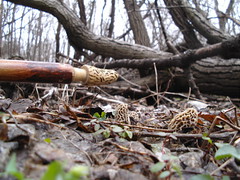
Tuesday, March 09, 2010

The morel reports are coming in...

Unfortunately they are from people finding them out in California and the Pacific Northwest. If you are ever in the need to track finds across the country, check out the mushroom reports and the brand new 2010 morel progress map over at Chris Matherly's Morel Mushroom Hunting Club. You have to pay to become a member and get access to all of the resources, but Chris is kind enough to keep his report and progression maps free and open to the mushroom hunting public.

I always enjoy following the progression of the season through these online maps. Michael Kuo used to have this feature on MushroomExpert.com before the reports coming in became too overwhelming despite numerous volunteers who helped organize the chaos. I mention MushroomExpert because it is another wonderful online mushroom resource that is rich with well-written, practical information (and yes the science stuff is there too for you true mycophiles). If you get a chance and have the means, you can donate a little to show your appreciation.

Getting back to the the progression maps, I was very glad that this gauntlet was picked up by Chris. Next time you send him a report be sure to thank him for his tireless efforts to track one of the most elusive and prized the wild edibles. It is very useful information if you are like me and look to the past to hopefully uncover trends that might help me better predict when to hit the woods and beat the others to those well known and well walked public spots.

If you take a look at the 2010 map, morel finds are slowly moving east. It looks like the first two weeks of March have brought them as far west as Idaho in the north and Arizona in the south. But don't let all those dots west of the Rockies distract you. The real show will begin when dots start popping up in the southern states like Oklahoma, Alabama and Georgia. I expect to see a dot in either Texas or Tennessee any day now, as reports usually show up by the end of the second week of March, but this was an unusually cold and snowy winter for the south as well. So, perhaps this is a sign that the season is off to a slow start.

Once this progression does start north, the season is on. In my own experience watching and tracking progress maps each season, it seems that reports progress north by nearly 5 degrees of latitude a week. That's about 350 miles, so keep an eye to the south and, if you are like me in Mid-MO, when you see reports of finds in Cape Girardeau and Branson, be sure to call in sick the following week. At least, if you are like me and love to go out and hunt them just to see them even if they are barely out of their primordia state and a mere 1/4 inch tall. If you are truly obsessive like some morel hunters I know, that is a perfect time to turn in your resignation notice at work, because in two weeks, weather cooperating, morels will be just start to be prime for easier spotting and eating.

Monday, March 08, 2010

Spring Rains and the smells they bring

I just stepped outside a moment ago and caught a whiff of something very familiar, the first spring rain. It's still nearly 60 outside and this is what I would call my areas first true warm rain, at least warm in the sense that I think of it. The aroma that teased my nose wasn't that rain smell, no that was there in the air, but somewhere underneath that I swear you could almost smell the earth coming to life. Unlike the deluge we had a few weeks ago, with this rain you can smell that loamy richness that means the mycelium is running once again.

No fungusy smells yet, at least not in my neighborhood, but I know they are soon to follow. Smells can be a hunters friend is you have a keen nose and an ability to follow the scent back through the breezes to their source. Now there are some that claim they can smell the mushrooms. In fact, I would bet that almost every hunter has made this boast at one time or another. Whether it be the true die-hard who claims to have a blood hound like sense to the average Joe Hunter who stops mid-woods and sniffs deeply and then proclaims "I swear I can smell them!" I have made some claims to the later only to find morels within a short distance.

Last year, I made a similar proclamations in front of Jon and Camoshroomer found some right where I was, so I say I have witnesses. They were much more suspect of my ability, but these times have to be more than coincidence. Sure I'm no pig, in the olfactory sense, though I have often been called one after taking on a plate of fried morels. But I swear, that morel smell is so unique in the woods and especially late in the season when they are putting up thousands, even millions of spores, I know you can smell them.

It's tracking the small that is the hard part. I am no blood hound either. But that won't stop me when I catch that all to familiar scent. I instantly stop and scan and sniff, gauging the wind to try and find the source. Sometimes I find something, sure it could be chance, but it seems to work so go with it. The one trick to remember is after you have found a few, every time you think you smell them, make sure you didn't just get downwind from your own bag. it gets me almost every time.


Of course the best smell of all is when you bring them home and start counting and cutting. It brings a smile to everyone's face, young hunters and old alike.

Monday, March 01, 2010

Morel Tales

With 50 degree highs predicted for this weekend, I know many people, myself included, will be just itching to get out in the woods. Why go out this early, you may ask? Well, for starters, it's time to get those legs back in shape so they can last all day stumbling through the brush up and down valleys and hills. Second, it is also a good time to scout spots and trees, since there is little foliage to block your view. Last, getting out now is also a good time to grab a tree identification book and hone up your skills.

For those of you, who might not be able to make it out in the woods quite yet, or have a whole lot more patience than the rest of us, you can partake in the age-old, pre-spring ritual of talking about morel hunts of the past. If you follow the message boards like I do, you see these stories being posted more frequently.

Now don't get me wrong, hunters are always willing to tell our stories so this happens all year. But there is nothing better to do before a season than to reminisce about season's past. Some hunters, and I am guilty of this as well, will look through all their photos to do what we call "train the eyesight" to that all too familiar pitted pattern.

One reason morel stories abound in late winter is that the fever is on everyone's mind. The slightest reference to anything mushroom or woods related will quickly turn to tales of morels. I have seen it happen in the line at the drug store, between complete strangers sitting three tables away from each other at a local diner, and while waiting in the doctors office. It doesn't matter where, in these parts morels are just on a lot of people's mind. And to many they are part of their heritage, so these stories represent local and family histories full of secret techniques and even more secretive places.

I do happen to have a degree in history and someday, if I am ever able to retire or win the lottery, I would like to travel the back roads of the Midwest and talk to all the old-timers I could find and write a book to share these rich histories and traditions about hunting wild mushrooms. I think we could learn a lot from these stories - not just about finding mushrooms, but about respect for the woods and the symbiotic ties between mushrooms, nature, and society.

But enough of that, let's talk morel tales. I will start us off, but I would like to hear from you as well. Please leave a comment about your greatest find or that one perfect day of hunting. I never get tired of hearing about hunting glory days, so feel free to post as many stories as you wish.

For myself, it seems that my most memorable finds happen when I am not even looking for morels. Let me give you an example. The last time I hit the motherlode in Rock Bridge State Park was back in the early 90's. It was late in the season, actually the first week of May and I had long given up on morels because I was in college and focused more on other things, but luckily they had not given up on me that year. It was a hot day and we were hiking the main trails when we came to a creek. This was back before they had installed a few bridges which now span the creek, so if you wanted to cross you had to wade. The only problem was that it had been a fairly wet spring and the creek at that spot was almost waste deep, so we hiked upstream to see if we could find a place to cross.

We eventually did and continued up stream on the other side looking for arrowheads along the edge of the creek. We didn't find any arrowheads, which is a good thing because it is illegal to take those types of artifacts from a state park. However, I was forced out of the creek bed by a deep pool of water and as I popped out and over the bank, I was taken completely aback. Staring me in the face were about 30 4-5 inch yellow just sitting there in a ten foot area.
I was with my brother who is not a mushroom hunter, but even he was amazed by the glorious site, so I took off my shirt (not having a bag) and we loaded it up. We picked probably 3 pounds between us in about 5 minutes, and holding our shirts closed as best we could, we forded back across the stream and headed to the car.

I came back the next morning with some other friends and we picked our fill. We did this for 3 days straight. Picking some huge late season morels with some weighing in well over 1/2 pound by themselves. To this day I have never seen anything like it. I wish I had been paying a lot more attention to mushrooms then because that must have been a glorious season. In fact, it was that fortunate find that rekindled my love for mushroom hunting that I had picked up around K.C. as a kid and I have been hunting in Mid-MO ever since.

Monday, February 22, 2010

Waking up from Winter - Day Trip Daydreams

I know it has been quite a while since my last post, but when the mushrooms disappear in winter, my mind turns to other things, mainly everything I neglect during the rest of the year while out wandering in the woods. Besides, now is the time when I do all of my spring cleaning. During spring, the only things I clean are morels on their way to the frying pan (Oh and occasionally I'll clean the frying pan).

Speaking of spring, I was down in Springfield last week when it was nearly 50 degrees. I could catch hints of spring in the air and knew it would be just a weeks before the woods start to come back to life. Something that was confirmed on my ride home as I found the true first harbinger of spring, a bothersome fly, buzzing around my head the whole ride back to Mid-MO.

As I drove back, I found myself noting elms and other known suspects along the way. You know how it is. You are driving along minding your own business and on the horizon amidst a small stand of trees is that alluring alluvial fan rising from the forest floor. Your mind races to past motherlodes, 25, 50, 100, 300 all under glorious elms. As you get closer you remind yourself of all the other elms you have seen that have produce nothing. But as it nears you see those peeling signs that this tree's bounty could be yet to come. And then you nearly drive off the road looking for pen and paper so you can write down the closest mile marker as a reminder of where to stop. Like you'll need one, just look for the rubber on the road. Come spring, many a prime tree are well marked by tire marks from cars screeching to a halt to pull over and check them out.

As the sun set and trees faded from the side of the road, except for a few right on the edge illuminated by my headlights, my mind began to focus on the primary question on every hunters mind right now. When will I find them first? This age old question is the foundation of much morel speculation, and I am sure that in some back room of Vegas or Atlantic City or perhaps even Boyne City, you can place a bet as to when you will find the first morel. I would have already started a website devoted to such bets and been a rich man, I am sure, except I have yet to figure out how to make people prove it. I considered requiring fresh samples, which at first seemed like a great idea, as I would get to sample the proof. But have you ever tried to get a die-hard morel hunters first morels of the season. No matter how many you find that first day, be it 2 or 200, there is not a one you can spare. Actually, discussing ways people prove their first finds is a good future topic, so I'll leave that alone for now.

By the end of the drive back from Springfield, I was beginning to see morel shaped constellations in the stars and I knew the fever had begun. Cabin fever is one thing, but it is nothing like morel fever--a steadily growing psychosis that begins in March and leads you to shun work, family, friends, and everything else. Early symptoms include: sudden urges to take long walks in very out-of-the-way places; increasing paranoia that someone else is walking your patch; and a driving hunger that only a handful of blacks, grays, or yellows can satisfy. Watch out, in the Midwest it is spreading faster than swine or bird flu ever could reaching pandemic proportions by mid-April. It is only a matter of time before it catches you.

Sunday, October 11, 2009

Mushroom class - update

Internet issues and work have kept me from posting before now, but I thought I would share a few photos from the mushrooms class. Here is Jon, coffee in hand, going through some slides explaining the different families of mushrooms. As you can see he had packed the presentation with many of his photos so those who attended got some good ideas of what to look for when trying to make an accuarte identification.

There were also plenty of mushroom identification books available to peruse. So folks could see which books they might like to go out and get for their own collections. Jon even had a few I hadn't got to see before, like this Boletes of North America, which I think will be on my Christmas list next year.

We spent the morning with a brief presentation, though once you get Jon talking, nothing is too brief. Then after a quick lunch break, we hit the woods to see what we could turn up. Besides giving info on mushrooms, Jon was also glad to impart some knowledge about mushroom photography as well.

Despite the lack of rain until just a few days before, we did manage to turn up quite a few specimens. Even managed to find on big old hen, and I stress the old part. Unfortunately this one was already turning yellow in the pores and one smell would tell you that it was way past its prime and could not be sampled. Too bad because it was large enough everyone could have gotten a good taste. I am holding only about 1/5 of the original.

Most mushrooms that we found that were fresh were small or growing on wood. Will is looking at one such specimen here.

However, there were still a few monsters lurking about. This unidentified Tricholoma was the largest that was found. It was on the old side and showed many signs of age, but was still neat to look at. You don't see too many large Trichs in this area compared to say out in the Pacific Northwest or other regions of the country.

After the hunt we brought most of our finds back to the classroom and Jon set out to identifying what he could. For edibles, in addition to the inedible hen, we had examples of chicken of the woods (yellow-pored), a smooth chanterelle, some nice and fresh hericiums, a really old man of the woods, and some even older disfigured purple gilled lacarria.

Jon and I, though mainly Jon since he knows the non-edibles much more than I, did our best to ID everything that was brought in. Becasue many were small, including several LBMs (little brown mushrooms) there were several that we didn't get an exact ID on, but we could at least suggest what family they were in and even narrow them down to two or three potential suspects.

All in all, in only about an hour looking along about a half mile of trail, the group managed to turn up over 60 different species which wasn't too bad considering how things had slowed down in the woods in the preceeding weeks.

All in all I think everyone had a good time and hopefully learned a thing or two about mushrooms, their characteristics, and what to look for when trying to identify them.

There have already been requests for more mushroom programs, so Jon and I are exploring setting up some more forays in the future, including a few official ones with folks from nearby mycological club like the Missouri Mycological Society and the Kaw Valley Mycological Society. Jon has started a email distribution list so we can let those who attended know about these future events. If you were not able to attend the class but would be interested in knowing about these, just drop me a line and I'll make sure you are added to the list.

Monday, August 31, 2009

Mushrooms 101: Fall Mushroom Class

That's right, if you have ever said you wanted to learn more about mushrooms, now might be your chance. Somehow, Jon and I talked the local staff at Rock Bridge State Park into allowing us to make an attempt to pass some of the fungal information in our brains on to any crazy person who manages to show up. So, come September 26, if you would like to hear Jon and I ramble on about mushrooms and our adventures, please feel free to register early and often. Seriously though,if you are interested, register now because space is limited. As in mushroom hunting the program is rain or shine, so if you plan to attend the afternoon hunt, please dress appropriately for the weather.

Here is all of the info:
Mushrooms in Mid-Missouri - Let's Have Some Fun with Fungi
Saturday, Sept. 26 from 10 a.m. to noon and 1 to 4 p.m.
Rock Bridge Memorial State Park
Program is free, but space is limited. Reservations are required. Call 449-7400.
Recommended ages: 12 to adult.
Program description: There are hundreds of different kinds of mushrooms growing right here in Mid-Missouri. Come together with others interested in this fascinating world of fungi for a day of learning and discovery. From 10 am to Noon take in a colorful presentation of photographs which will help you learn to identify some of the many different types of mushrooms, as well as edible and poisonous ones. At 1 p.m. we will host an optional short hike where you will find some mushrooms, then bring them back for identification and discussion.

Hope to see you there.

Monday, August 24, 2009

Fall mushrooms are on their way

With night-time temps dipping down into the 50s over the weekend, the fall mushrooms are sure to be here soon. But before you start looking be sure to use extra caution with some of the more popular fall edibles.

Now I normally do not talk much about edible mushrooms that have deadly look-a-likes, but after several reports from many of you I decided I had better say something. The mushroom or more precisely mushrooms, since this is really a whole family of species is the honey mushroom. This is a rather popular mushroom, mainly because it can be found in large masses of clumps and grows quite well in many Missouri woods and lawns.

One of my favorite mushroom identification books is David Arora Mushrooms Demystified. Arora lists five basic characteristics to identify a honey. The mushrooms must:
  1. grow in a cluster
  2. have white spores
  3. grow on wood, or buried wood/roots
  4. have a ring, and
  5. have stringy white pith in the stalk
If any one of these characteristics is not met, then there is a chance that it is not a honey. Pay extra close attention to the second one. A spore print can make all the difference. In fact, I don't recommend even chancing it with honeys, do not eat them unless you spore print every one. Now, I know that sounds awfully tedious, but before you send me an email, let me explain why.

If you have ever come across a mess of honey mushrooms you could see how it would be easy to pick huge bagfuls very quickly. The clusters are usually big with 20-30 mushrooms easily, plus there are usually a lot of clusters around, sometimes even hundreds of them, meaning you could easily come across a field of thousands of mushrooms. In fact, I see this scene almost every fall.

The culprit that ruins the mix is aptly named the deadly galerina (Galerina marginata or older books call it Galerina autumnalis). The problem with this particular mushroom is that it has very similar chaaracteristics. For example, it often grows in clusters and is found on wood. It has a ring and can be the same color as honeys. It also grows in the same places that honeys tend to grow at the exact same time of the year. Granted you can find deadly galerina all year long (making them a ringer for anotehr edible mushroom in winter, the velvet foot, which is another story). As their original scientific name suggests, galerina autumnalis are very common at the same time of year that the honey emerges, in the fall. More importantly, this mushroom can be so toxic that all it may take is one single mushroom to kill someone.

All of these things add up to big trouble in my book. An unsuspecting mushroom collector might easily mistake a cluster or even a single mushroom and mix it in with the honeys they have collected. Once that is done, it is the fungal version of russian roullette as anyone who consumes the wrong mushroom(s) would most likely not realize it until major organ failure had begun to set in. The only real way to tell the two apart is to check the spores, which in the galerina's case should be rusty or brown. Sometimes you can tell just by looking at the gills, which are usually brown. However, I have found young deadly galerina that had perfectly white gills, so the only way to be sure is to take spore print.

Here are a few pictures of the two so you can see how easily they can be confused with each other if you only rely on looking.


Here is a small cluster of deadly galerina, taken by Steo from Ohio. Notice how white the gills appear. The ring on the galerina is very thin and will often fall off (as is the case here), so although these are not a close look-a-like to a true honey, I have included this photo because many might mistake them for the ringless honey mushroom which has been in abundance for the last few weeks.

Here is the honey mushroom that is most common to my parts of Missouri (photo by Jon Rapp). It doesn't look much like the galerina above and you may think that you can easily tell the two apart, but remember there is a lot of variety in the way these mushrooms appear. Compare this photo to the one below from Mushroom Expert.

This one looks pretty darn close to the ones above but it is of galerinas. I have actually seen both of these growing together on the same log and around the same tree. If you aren't extremely careful, it is easy to see how one mistake could be a person's last.

Here is a close up to show you the stringy white pith that is found on the stalk of true honey mushrooms. But before you decide to go by that, look very closely at the galerinas above. From the photo, they almost appear to have a similar pith though it is not so stringy. So, always let the spore print be the final judge. If it ain't white it's not right!!

I hope I have thoroughly discouraged everyone from seeking out this mushroom. The fact that Michael Kuo didn't include it on even the expert list of 100 Edible Mushrooms should tell you something. If you encounter it, do what I do and just let it be. More than likely, they are buggy and personally, I prefer many other mushrooms over honeys. It is best not to bother with this one until you are an expert and trust me, I am no expert.

However, I can't leave this entry on such a downer. So lets talk turkey. Well, ok not turkey but another fowlish freind, the hen of the woods. After several reports of hen finds north of Missouri, I decided to check some early hen trees last week, but I did not see a thing. Though if the rain keeps up, there should be a good batch of them again this year. Last year, you could hardly walk 1/4 mile without stumbling one if you were walking the oak hardwoods and I picked my first one the first week of September, so they are not too far away.