Friday, April 02, 2010

Morels for some while most get skunked (some literally!)

I keep getting reports and checking from the boards I need to update my maps. Here is a photo sent by Shane Jr. from Hillsboro, MO. Way to go Shane Jefferson County will be on the map when I update it tomorrow night. Thanks for sending me the report and photo. Makes me a little jealous. Oh what am I saying it makes me a lot jealous.

I have been out the last few days finding no morels. On Thursday the first day I actually looked I spent an hour just working my way to my patches. I had to work around and wade a few sloughs in the woods that were backing up with flood waters shooting down from the north. After finally getting to my spots, I looked extra careful and did not see a thing.

To add insult to injury on the way back I literally got skunked, as I came face to face with one of the little varmints not four feet away. I saw him turn tail. To run or to spray I will never know because I was not about to stick around and find out. I took off in the other direction as fast as my out of shape legs could carry me (remember it was my first day in the woods and I was on the way home). Luckily I escaped but I took that as a sign and headed back to my Jeep.

Today I went out with Camoshroomer for a few hours scouting to no avail. Meeting up with a larger group of morel hopefuls tomorrow, so who knows we may just be able to turn up one or two yet. Although many signs are right (redbuds and dogwoods are budding, my forsythia is in full bloom, and many trees are already showing their green leaves) things seem a week behind for morels, but this good rain has some promise as long as the rivers don't rise too much more.

Monday, March 29, 2010

MO Morel Reports Increase

Here is the classic photo evidence of a morel sighting in Springfield posted on the Morel Hunters Missouri board by Kawryan, an administrator over at Morelhunters.com. By the way, that website which is only a month or so old, has quickly grown to become an impressive set of resources and a friendly online community for mushroom hunters to gather (no pun intended).

I checked the morel report boards and updated the map at the top right of the blog. I'll make a list of all the boards I regularly check at the end of this post so you can try to track them yourselves, if I get too busy picking later this season.

To my surprise mainly due the lack of posts from MO prior to Sunday, there were quite a few including one from someone as far north as King City and one who reported finding 10 right in my own backyard near Columbia. To be honest, this is a little farther north than I expected, but the early bird gets the worm and there are sure to be micro climates that have been warm enough to start things flushing.

Now, some of you are undoubtedly Show-Me'ers and might have doubts about these reports. So before you email me with them. keep in mind that I do not even attempt to judge the veracity or truthfulness of these reports anymore. I just take them at their face value. I ask myself why would someone want to lie about finding morels and who am I to judge. I mean, so what if they are lying? All they are going to do is get me out of my lazy chair and in the woods sooner. I should be thanking them for the extra motivation.

Also, I have doubted crazy reports early in the season of people finding 300 well before anyone else. When I did I was almost always proven wrong, so I learned long ago not to get into these arguments. They aren't worth it. Besides the only thing that really matters is that I haven't found any yet. Never mind the fact that I actually haven't even gone looking. I'll find my first this weekend. That is what I predicted and the first rule of actually meeting your prediction is to not hunt a day sooner, so now I patiently wait for April 2. I would go look on April 1, but why bother no one believes any April Fools Day reports, though I bet most, at least the modest ones will be true.

Here are the morel report boards that I check. I compile these with reports I am sent or told to produce my MO morel report map:
Mushroom Report Board at the Morel Mushroom Hunting Club
Report Board at Michigan Morels
Mushroom Reports at OutdoorMissouri.com
And last and least: the Missouri report board at Morels.com

Sunday, March 28, 2010

The Do's and Don't of Eating Morels - or how not to get sick

Every year, I hear or read of at least a few reports of people getting sick after eating morels. Some of these are from people who have never tried them and have an allergic reaction to them -- which is a good reminder to always only eat a little bit the first time you try morels or any wild mushroom to ensure no unpleasant reaction before eating more. Due to this fact, before the season begins, I always find it necessary to mention some tips to avoid getting sick or even worse from the morels ones picks and ingests. I can honestly say that I have never gotten sick from eating morels but I suspect these simple rules have served me well.
  1. Never eat any false morels including so called "reds". I know there is much debate about this, but like I said these are my guidelines and so far they have done me no wrong. For more information about the eating false morel debate see this previous post The Debate over Reds - To Eat or Not to Eat.
  2. Never eat morels raw. Anything raw can and usually does have bacteria on it. Cooking it, even a fast sauté will destroy the bacteria and save your stomach.
  3. Never eat any spoiled or bad smelling morels. This is more important late in the season. Usually if a morel looks or smells bad I just let it be. When I get home I always look mine over thoroughly and cut off any darkened pieces or parts with that rust colored rot starting to set in.
  4. Always be sure that you know where they grow. This is by far the most important one because this is how you can actually poison yourself by eating morels. IF IN THE WOODS, YOU ARE GOOD. Never eat morels from lawns, orchards, etc. unless you have verified that the area has not been treated with pesticides or herbicides for a very long time. Any poisons in the soil WILL be absorbed by the mushrooms and if you eat them, by your stomach. For all you Show-Me folks who may have doubts, check out this article on arsenic poisoning by morels.
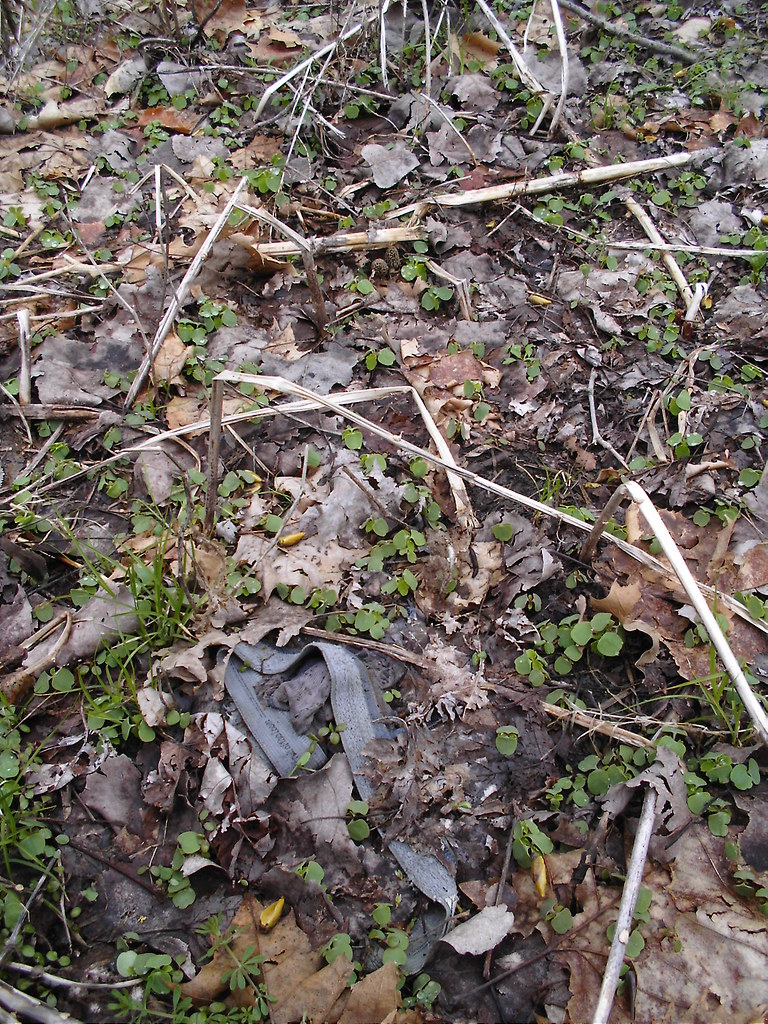
    Even in the woods sometimes you may have questions. For example, would you eat the morels in this picture (to the left) growing less than a foot from someone's old fruit of the looms? These were out in the woods but they still gave me pause.
  5. Never eat too many morels. I know, some of you may argue that there is no such thing as too many morels. But like most things in life, morels and mushrooms are best in moderation.
  6. Finally, there is the alcohol warning. Some say don't eat morels and drink at all. Others say you can have a beer or two just don't over do it. I have done the later and had a drink or two when consuming morels but never too much. Others swear it just took them a sip, so if you drink, you are going to have to see where your tolerance lies. For those who want to be safe, just stick to soda or some less potent potable.
Well there you have it. Just some general guidelines to follow. After all the time you spend driving and hunting down your patches the last thing you want to see is your half-eaten morels and all that hard work getting literally flushed down the toilet.

They're Here - MO Morels have arrived!

Well, it is official, the reports of morel finds have begun to trickle in from the south parts of our fine state. Yesterday, I received word of finds in both Cape Girardeau and from the Joplin area. That means it can only be a week or so before the first finds in Mid-MO start.

Now before you gas up the car and head south to get in an early hunt or two, let me just warn you by saying these early finds are relatively small. If you are wanting to go on a road trip to find the motherload, you had better head farther south (like to Oklahoma or Texas). The report from Joplin was of three whole morels and my buddy near Cape didn't even pick any of the ten or so blacks that he found because they were all still well under 1/2 inch in size. You can't rush a slowly developing season like this and just have to be patient unless you have the freedom and time to travel, like Camoshroomer did last year when he headed out to Georgia to get his first fill.

Anyway, things seem to be right on time maybe just a 3 or 4 days behind. I expect if we get some good warm days in a row with day time highs above 70 and nighttime lows about 50, then the ground and the morels will really start to heat up, so dust off those old hunting clothes and get them all treated with pyrethrum because it won't be long now. I hope to find my first on Friday (April 2) if I can manage it.

Happy hunting and please keep those reports coming in.

Friday, March 26, 2010

How to Find Morels


This is probably the most often asked question I get this time of year and I wish I had some simple answers.
Morels can be found nearly anywhere and nowhere at the same time. However it all depends on where you hunt and what is hot that season. Before I begin let me say that this is how I find morels. There must be a thousand other techniques that people use, including lucky sticks and crazy car rituals on the way to the hunt.

I know hunters in Kansas, Oklahoma and Texas who find morels in the grass around cedar groves. Goerge posted a good video on the Moreltube showing this at the new MorelHunters.com website. I also know a hunter in Ohio who finds morels annually in a field of switchgrass far from any trees. I have found them in city parks, along well used biking trails, and once I even found them growing in my own backyard. The only rule you can count in morel season is that you can't count on the morels. They grow where they want to when they want to and usually not convenient to where you live or your schedule.

Despite the lack of simple rules, there are a few guidelines that you could try to help you in your search. Mainly this involves a lot of scouting. First, scout around the Internet. You'll find all sorts of references to morels being found in abundance around certain trees (like dead elms). Check posts from past years and make note of what trees are mentioned and when the finds were made. Then learn to identify these types of trees.

Next you have to scout the terrain. If you are new to an area there is nothing else you can do but walk. When I started hunting around Columbia, I went out for a drive on a day when I thought morels should be out there. I found an area of public land that looked very promising judging by all of the pick-ups in the parking lot and along side the road on the way in. I got out and walked for about 4 hours to find 2 morels.

I kept returning to that area covering more of it and checking around every large or dead/dying tree I found. This was slow going at first. So I also followed other peoples tracks and when I saw stumps, I made notes of what was nearby. Gradually, through my own finds and noting those of others I could narrow down the best suspect trees for the area that season and then I just targeted those. By moving fast and checking every type of the hot tree or trees out there I could find 200 to 300 in about 3 or 4 hours. Sure you may miss a few in between here and there moving that fast, but if you keep an eye out, you end up stumbling into new patches that you can search slowly and surely.

In the end that is how I do it every year, trying to figure out the rules for that season by the end of the first week. That is why I get out early and find the first morels. I don't even pick them. I cover them up for easy pickens later. However, the information they glean about what is hitting this season is invaluable later during the height of the season when everyone else is just starting to figure this out.

For example, by knowing the prime trees I have skirted by other hunting parties working back in front of them and hunting out all of the good trees literally minutes ahead of them. If you clean out a hot spot right with a light hand and foot no one will ever notice.

Anyway, spots may come and go, but if you master this technique, you will never come home empty handed. This is how the guys who hunt from state to state do it, I bet. The have so many years of hunting so many areas that they generally know what to look for in each of them. Also, they know other hunters who do share information about what is hitting because when things are hot there are too many mushrooms for even one die hard team to pick.

Sorry it is not so simple, and I am sure that there are many other ways to find morels. This is just what works for me. Do everything you can including bribing other hunters to figure out what rules work for your area. Hunters are very careful not to talk about these things but every now and again after a good hunt and a few cold ones they might let something slip. If you do a good job scouting you'll end with a nice reward at the end of the day. I can hardly wait until I see the first pan of the season on my stove.

The Psychology of Morels

If you are a morel hunter or know anyone who does, than you are probably well aware that morels do a strange things to people. Often this is called "morel fever" and although I doubt you will see it in the latest edition of the physician's handout, it is a well-known and experienced phenomenon. And there is a clear theoretical explanation for this which I derive from years of observation and personal experience.

For those who have taken a basic psychology class in high school or college, you may have seen or heard of Maslow's hierarchy of needs. I won't bore you with all the details because you can read for yourself, but this theory basically says that humans focus on their needs in a specific order. First focusing on basic needs to live, like eating, drinking and sleeping. Once these are satisfied, we focus on safety such as housing and other comfort needs, only moving on to emotional needs like love and companionship once safety needs are satisfied, and so on and so on.

Well I doubt Maslow ever knew a morel hunter because come morel seaosn his hierarchical pyramid would clearly look like this. Come April in Missouri, most hunters will shun the most basic needs including food, sleep, and even sex in an effort to check out that next tree or patch of woods. Only when our bellies and our freezers are full of tasty morels do we start to remember and address the other needs.

I would even reckon that somewhere at sometime morel hunting has played a hand in more than one divorce. I have often heard rumors, but never seen this verified. If anyone knows of such a case please do share. I do not of relatives who no longer speak to each other for previous raid into personal spots. Sometimes even blood isn't thicker than morels.


Thursday, March 18, 2010

Finding the elusive morel

I mentioned one not so commonly discussed way that some people sometimes find morels in my last post (using their noses). I figured that while everyone was waiting for those early reports to come rolling in from the south, that I would mention a few other potential methods that I have heard about over the last few decades. Some of them have been tried and true, while others are what I would call more "experimental" techniques.

You may encounter the first one if you hang out on some of the regional or national morel report and mushroom message boards, though I have yet to actually meet one in person. And that is a true morel hunting dog. Now I have heard talk of some hunters (and even met a few) trying to train their dogs to sniff them out and this does in fact seem very feasible, knowing that dogs, like pigs, have been trained to effectively find truffles growing under the ground. And it sure would be nice to get a full trained morel hound. But the fact that there isn't a training business offering training session for morel hunting speaks a little to the difficulty of this task.

Now I have heard stories from reputable sources (at least as reputable as morel hunters can be) of a few old timers who had proven on more than one occasion that there old dogs could really track them down. If anyone knows of similar tales or even first hand experience of dogs smelling them out please let me know.

In my own experience taking dogs I would say they were rather useful in spotting morels. Not that they pointed them out or anything like that. It was more due to my persistent fear that in their tromping along with us they would step on a good morel. And indeed this was the case as I quickly found a morel squashed by the paws of a hound. For the rest of the hunt that day I obsessively scanned the earth in front of each step and my intense obsessiveness saved at least 30 morels from a similar fate. Needless to say I did not go out with dogs since. It was far too stressful. I have enough worry just making sure I don't step on one.

Another tried and true method is what is often called "road hunting or trolling." This usually involves driving slowly down wooded dusty back roads, scanning under bushes, along fence rows and any general potential spot you may see them. This is best to do later in the season when the big yellows are easy to spot, but those with a keen eye can pull it off sooner. There are a few dangers to this technique.

The first of course is that you are driving without looking at the road or oncoming traffic etc. Thus, I do not recommend this approach unless you broke a leg and can't get out in the woods. Slow is the word to stress, drive very slow. The second danger is that this will often put you at odds, as when you do see morels, you most likely won't have an idea whose land that is and might be risking a trespassing ticket or worse in some parts of Missouri, as often many people will protect their personally owned family patches with shotguns. I would never condone this, but it is private property and like it or not you never know who may be just over the hill and you should respect their rights. Besides you can always go to closest house and see who owns that land then ask permission. You'd be surprised how many people don't mind. Also, you might bump into that old timer who can't get out and walk his patches. By offering to check them for him and split the bounty, you can gain access to some very private and prime spots. This is well worth the trouble in my opinion.

Now please do not confuse "road hunting" with what I call "drive by hunting." Drive by hunting is usually done when you are not actually out searching for morels. It's the time on your way to work, or driving back from the store, that you see that prime dead elm, or other known producing tree just sitting off the road. You slam on the brakes, pull over as safely as possible and hightail it to the tree, noting if there are any other skid marks on the road as you step off into the woods. Most times you come up empty, but there are always those few stops where it all pays off and you pick a bushel when you weren't even officially looking for them. Keep in mind this usually only happens when you are running extremely late for work or something equally important. For example, if your wife is pregnant and just called you to tell you to head to the hospital, do not even look at the trees or the motherlode tree is sure to appear.

The last method falls into that experimental category. Over the last four years or so, I almost always see someone asking if one can you hunt morels by black light at night? And if you have ever seen a ghostly white morel in mid-season, it is easy to believe that this could be the case. I can honestly say that I have not tested this theory. The first challenge would just be finding a true portable black light that you could take into the woods. I intend to test this theory out though this year, by finding some morels placing them in my backyard and then using a large black light I have a Halloween decoration to see if it really would light them up and make them stand out. So, the results pending on this one.

That's just a few methods and I'll try and post some more in the coming weeks. If anyone has any of their own out of the ordinary methods, please leave a comment and share them.