Tuesday, June 24, 2008

Are Mushrooms Good for You?

We all know that mushrooms are fun to find and delicious to eat, but in a recent chat with a local park ranger, I was asked about the nutritional value of mushrooms. To be honest, I hadn't given much thought to this before. I knew that some mushrooms had medicinal values and were used in treating and preventing cancer, heart disease, and other health conditions, but I had never bothered to do much research on how healthy they actually were.

So I did a little digging, first through my books at home, and then online and at the library. I was rather surprised by what I found. Now keep in ind these are numbers for mushrooms cooked plainly. Adding breading and butter or stuffing them with cheese, etc. will, of course, increase these numbers. Here are the nutritional highlights of common Missouri edible mushrooms:

Morel, 5 medium (84g)
Calories: 20
Protein: 2g
Carbohydrate: 3g
Total Fat: 0.0g
Fiber: 0.0g

Chanterelle, 1 large
Calories: 1.7
Protein: 0.12g
Carbohydrate: 0.35g
Total Fat: 0.02g
Fiber: 0.13g

Black Trumpet, 5g (dry)
Calories: 15
Protein: 0.12g
Carbohydrate: 2.4g
Total Fat: 0.02g
Fiber: 0.6g

Lion’s mane, 5 medium (84g)
Calories: 20
Protein: 2g
Carbohydrate: 3g
Total Fat: 0.0g
Fiber: 0.0g

I also found a nice table listing the nutritional values of some common mushrooms.

(Source: Paul Staments, Mycelium Running, p. 198-99)

From the numbers it appears that mushrooms certainly aren't bad for you and certain varieties are loaded with beneficial nutrients. As Staments points out, even the FDA has "officially designated mushrooms as 'healthy food'" (p. 197).

So eat up, but always remember to eat them in moderation and always be certain of your identification before eating anything.

(For more information on the medicinal benefits of eating mushrooms, check out the listing on http://www.anti-aging-guide.com/41mushrooms.php. I don't promote the site itself but they have a concise listing of recent articles focused on the subject.)

Monday, June 23, 2008

The Tasty Colors of Summer - Black, Yellow, Red and Blue

Sorry folks I know I have been MIA for a while but so have the edible mushrooms. Despite the abundance of rain the woods near me just weren't showing any chants, chickens or anything else. Despite my disappointment, I had a feeling my luck would change over the weekend and boy what a weekend it was.

I am always looking to learn more about fungi and what it edible among them, so I headed to a foray down at Ha Ha Tonka State Park on Friday with camping gear and mushroom baskets in tow. People may laugh at a hunter carrying a basket but when you come back with smooshed chanterelles (which are much more delicate than morels) you will soon understand why baskets are superior.

Anyway, the foray was hosted by the Missouri Mycological Society , or MOMS for short. I had recently had some email conversations with them about starting a Mid-MO chapter so I figured I had better check them out so I could see what they were like.

A better bunch of people you will not find. When I got there I was greeted warmly and with fine food and drink. Speaking of food and drink, I don't think I have ever feasted better on a camping trip in my life. From venison burgers to chicken of the woods goulash, I quickly realized how these people kept up the energy to go trapsing around mile after mile all day long, bringing back all sorts of fabulous fungi, but more on that later.

As I set up my tent, thinking of the woods, a fellow hunter came back after a ten minute scout in the woods right around camp with a basket full. There were many specimen in there but my eyes first noticed the beautiful clean yellow chanterelles in one side and next to them a larger pile of black trumpets.

Never having found a fresh black trumpet, the patches I found last year had only dried up mushrooms, I was instantly consumed and finished setting up the tent as fast as possible so I could hit the woods.

There was a beautiful group of chanterelles growing right at the trailhead across from camp, which is always a good sign. I spread out with a few others and we quickly got separated as we begin to focus on what was on the forest floor and less on each other. For the first hour, I could not find my own patch. Everyone else I saw had a good mess of them, but I had only a handful. After some time I realized my mistake as I stumbled across my first patch, which in this case seemed to be growing at the bottom of the sloping woods. I was working mainly up and across the top, like I would for yellow chants which explains my lack of them.

Realizing my mistake I backtracked and quickly picked a pound or so. What a marvelous smell they had. It was very fruity like common chants but much stronger and more pronounced. It was a sweet smell to my nose. And soon back in camp, I was eating some prepared by Shannon, the organizer and host for this foray. If anyone of you has read 100 Edible Mushrooms you may recognize his name from the section on eating pickled stinkhorn eggs. Luckily, I did not get to try any stinkhorn eggs, but the wild mushroom medley with broccoli was delicious.

When I wasn't picking, I did manage to take a few photos.

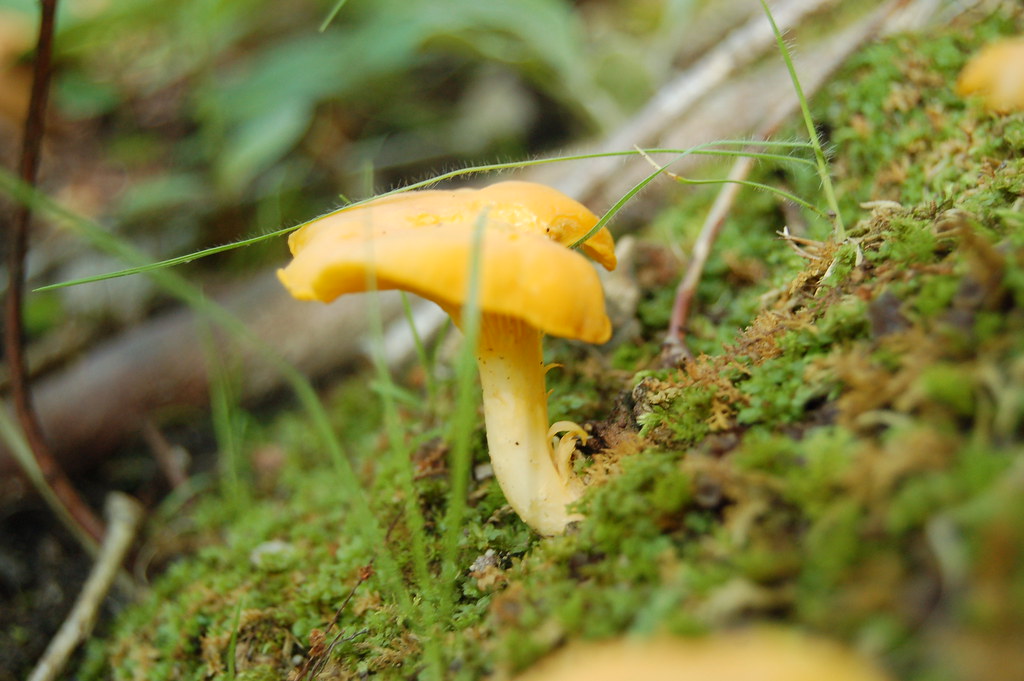
First, here is a common yellow chanterelle. I didn't see any smooth ones yet, which is what I usually pick but these were everywhere.

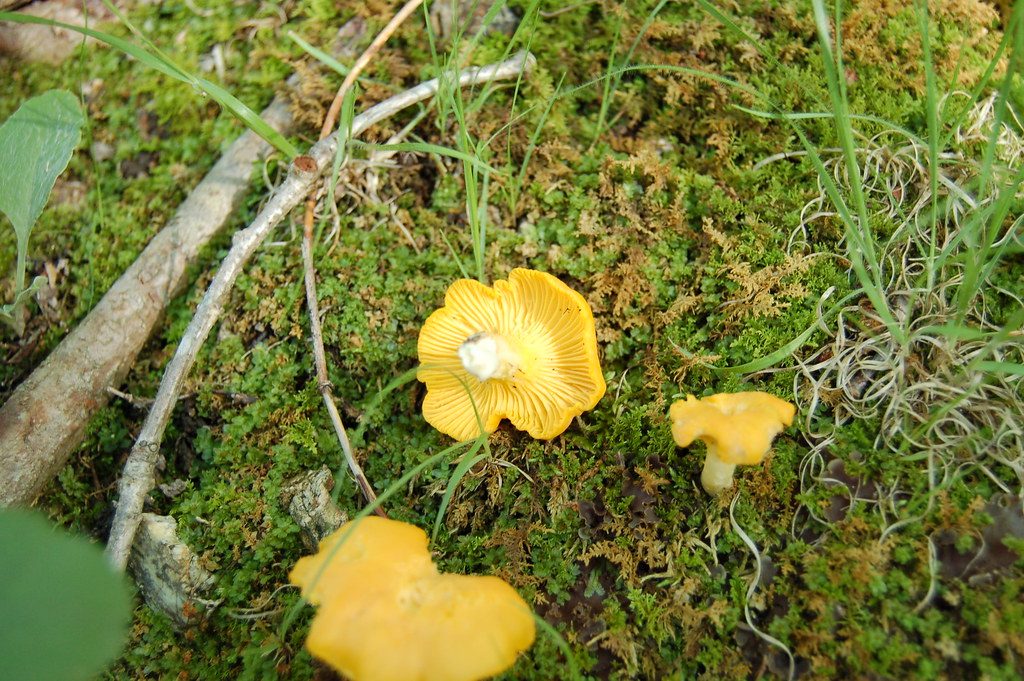
Here is a photo showing the underside . Notice the ridges instead of gills on the underside. I mainly picked the ones growing out of moss because they were especially clean as you can tell from this one.

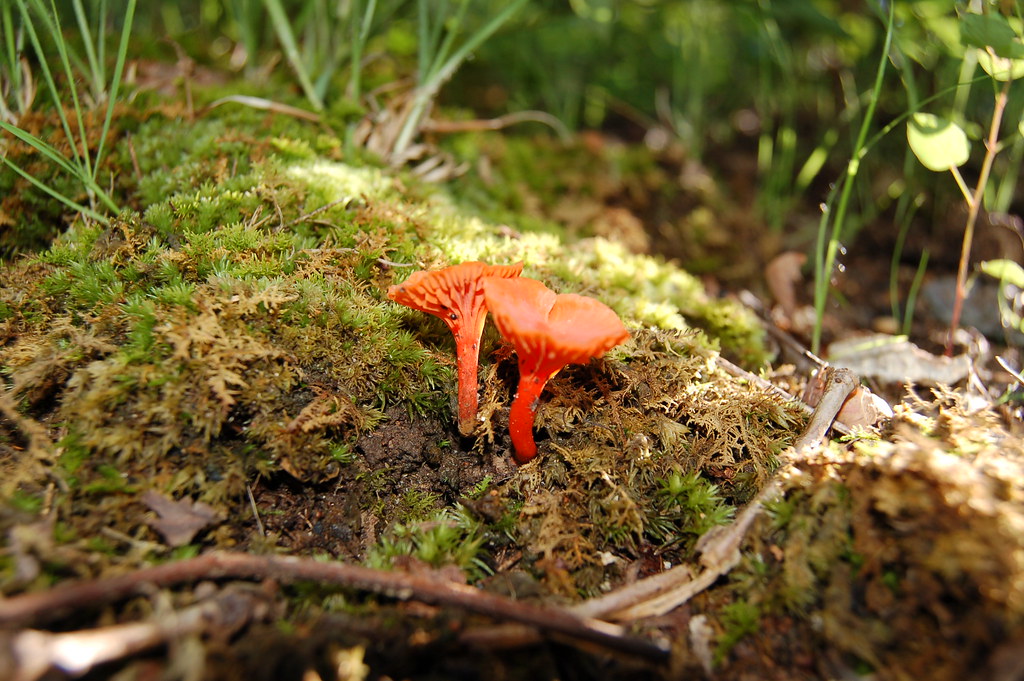
These brightly colored chants are cinnabars. They were everywhere, which is good because you would need a lot of them to make a meal. The caps are usually the size of a dime. They do not add much flavor, but they sure do add a lot of color to chanterelle dishes.

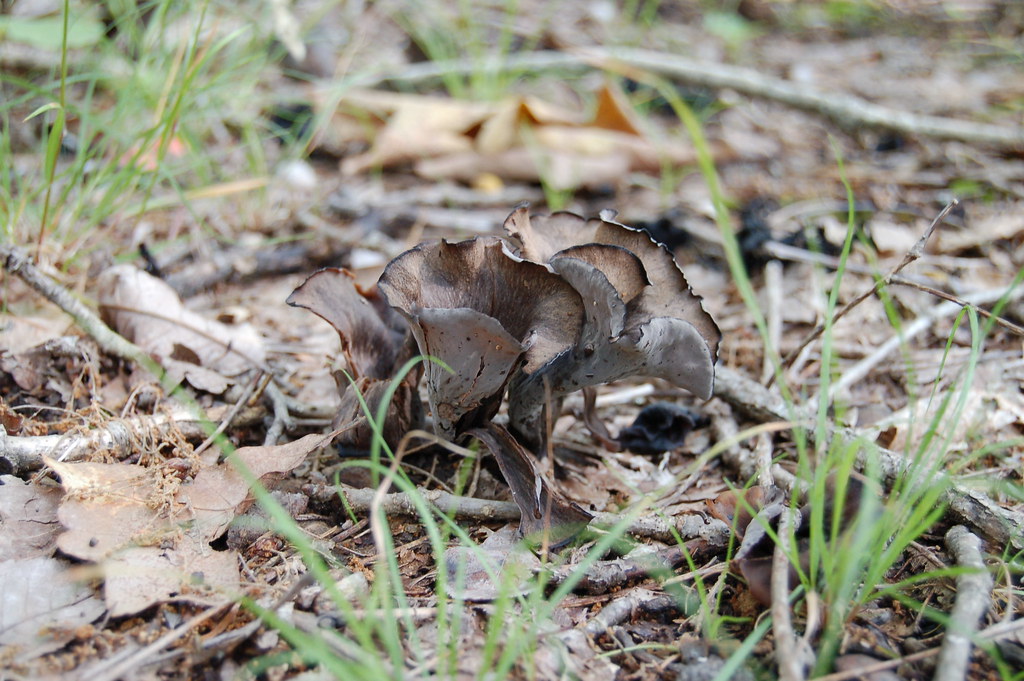
And here is a cluster of black trumpets. When you see this look around because, like morels, there are always more to be found. Unlike morels, there is lots more to be found. I picked a full lunch sack sitting in one spot for ten minutes and not moving an inch. They can fruit in quite an abundance if conditions are right and boy were they right.

Here is the same cluster from another angle. I tended to find them near moss, but let me stress the word tended. Being, in my humble opinion, one of the hardest mushrooms to see, I often first find them by looking for black in patches of moss. But I don't really think they have any true association with moss, as I found huge patches with no moss anywhere. They did however tend to grow around oak trees.

Here is a cluster that was no where near moss. Notice how the tips are starting to dry. They dry out fast and don't stay fresh long, even in moist conditions, but they fruit constantly so you can find fresh clusters throughout the season. You can see some dried up ones in the background of these photos.

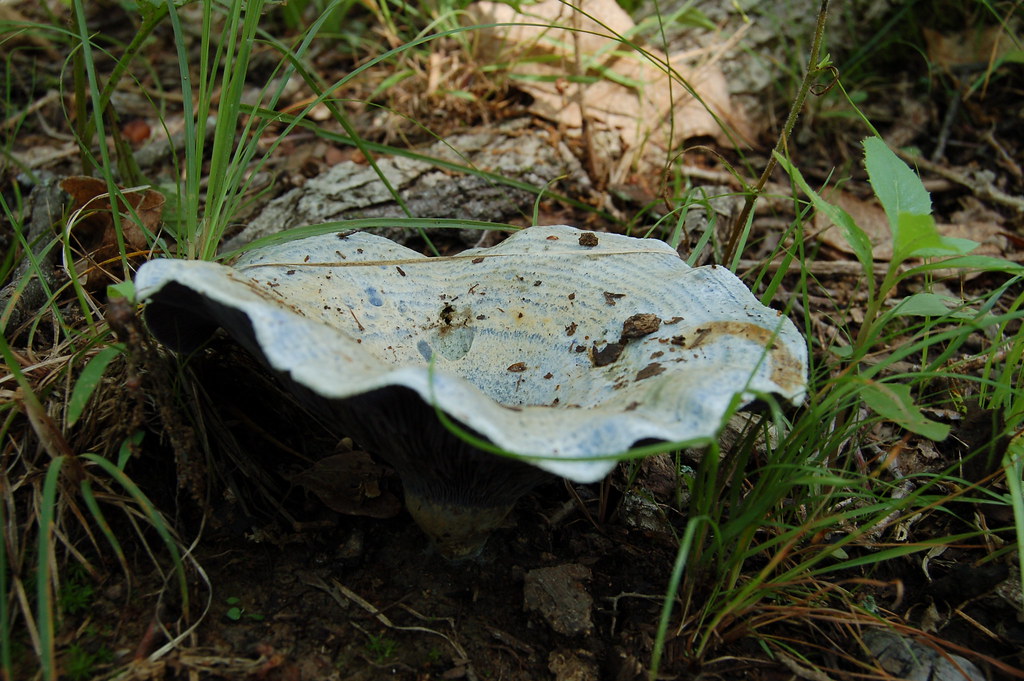
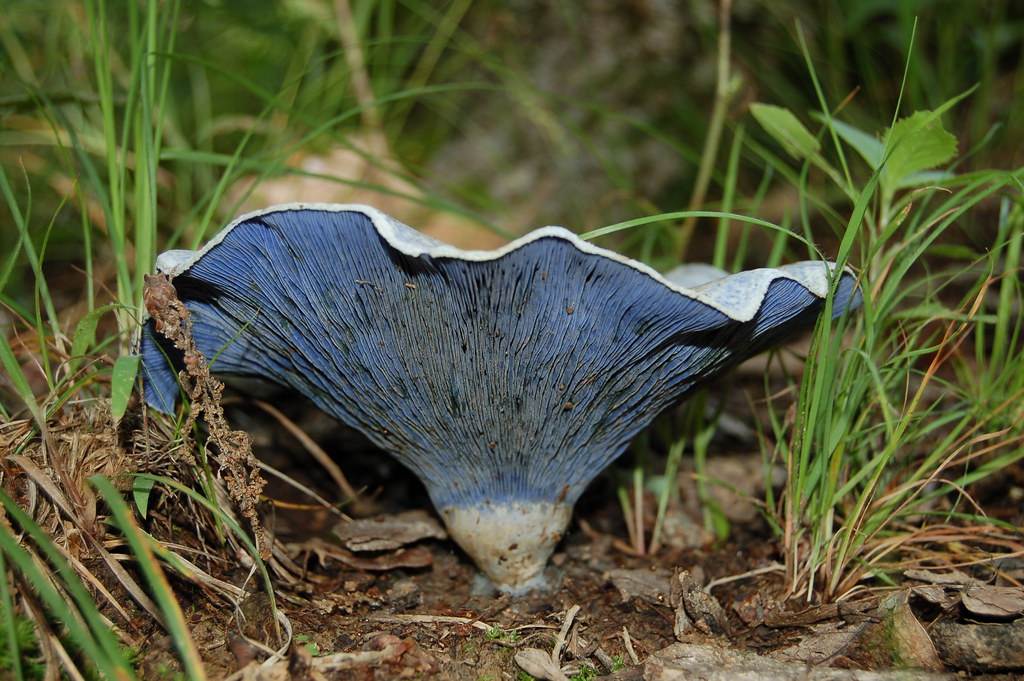
This was a special find. Have you ever seen a blue mushroom? Well now you have and can you believe it is edible. Well, it is and it is mighty tasty. You cannot mistake indigo lactarius for another mushroom so it is a great one for beginners.

The gills are completely blue and when cut bleed a blue milk, giving it the common name blue milky. It is quite tasty and for a special treat for the kids slice it up and cook it in a pan with some eggs for breakfast. Even if your kids won't try the mushroom, they'll be sure to love the green eggs. Now if only I could find some green ham...

All in all it was a great weekend and I learned an awful lot from the MOMS folks. But I will save that for future post on the benefits of a foray.

Saturday, June 07, 2008

After the Morels…

Jim left this comment earlier today on a post from last year about chicken of the woods:

hi, i just wanted to see what was up next and i stumbled across your site. we found about 15 pounds of yellows and greys this year, in chicago's southwest suburbs, mild compared to some people we know, one of which found a verified 115 pounds of them in about 4 days! I'd post a photo aof a nice large cluster of five that i found. Anyway, I'm wondering whats next? Chanterelle etc? I didn't think sheepshead we're until fall. (reddening lepiotia is coming up soon i know) I saw and appreciate your recipie on chicken mushroom and wil try them again. I have cooked them 3 different ways so far, always very woody in texture, almost unchewable lol. taste good though, kinda like mushroom gum :) happy hunting, jim

Well, Jim, I have not been able to find all of the edible mushrooms that grow in Missouri, but I can give you a good general idea of some of the more common and easily identifiable ones. I have never tried reddening lepiotia, though I have seen them. How do they taste?

But before I go on to talk about the other edibles, let me address you texture problems with the chicken of the woods. Being a polypore, it gets very tough with age, so when I find one, I only cut young specimens or the outer edge of older ones. Usually just the first one or two inches, because it is the most tender. Try those harvesting tips next time you find one and see if it improves the texture.

Now back to the matter at hand. Here is a general run down of some common and easily identifiable edible mushrooms in Mid-MO along with some general times for when they flush:

  • Oyster Mushrooms – Can be found anytime of the year after a few days of rain. I have even found them in the dead of winter when it only gets above freezng for a few hours each day. I usually find mine on dead elm or willow trees, but they grow on many others as well. It is a saprobe, meaning that it gets its food from dead organic matter, so it is always found on dead trees/wood. It can be a frustrating find because often clusters grow way up high and well out of reach. I have known hunters to take telescoping tree trimmers out in the woods when they find a tree with some nice high clusters.
  • Black Trumpets – or black chanterelles, can be one of the hardest edible mushrooms to spot. Found from June through August, trumpets blend in so well, that one is usually first spotted growing out of moss where it stands out in contrast to the deep green carpet. Even then they can be hard to spot, but once you do, do not move. Like morels, they grow in patches and you’ll usually find yourself surrounded by many clusters once you start looking closely. They have a very rich flavor that is greatly enhanced by drying them. Use them sparingly because a little trumpet goes a long way.
  • Chanterelles – like black trumpets, chants can be found from June through the fall. I have found them as late as the first two weeks of October. There are many forms of chanterelles but I have only found three so far.
    • The most abundant is the smooth chanterelle. This orange beauty grows in large patches usually near oak trees in the Missouri hardwoods. They fruit abundantly when moisture is good and are one of the tastiest edible in my own humble opinion. More than any other chanterelle, they really have a nice apricot smell to them. A full bag smell very fruity. When they come up, try and get out and pick them as fast as you can, because the maggots really like them and late in the season it can be hard to find any bug free ones for the table. These are easy to identify because they have no gills on the underside. As the name implies it is very smooth with only a feint impression of the ridges.
    • Nex,t is the common yellow chanterelle. I often find these along small creeks and along the trails at local parks. This one can be found at the same time as the smooth chant. It has true ridges which run down the stem and are distinctive from gills because they do not easily detach from the cap. Once again the apricot smell is a good give away. It also grows in patches though they tend to be smaller. With lots of rain they can be a pain to clean as dirt that is splashed on them becomes embedded as they grow.
    • Last, is the cinnabar. This red little devil is a real treat to find and quite a beuty to behold. Although its small size usually does not lend itself to pounds and pounds, when you find enough of them to eat, I highly recommend trying them. They may be the best tasting chant, maybe. I often mix together all three chanterelles when cooking, the coral pinkish red, yellow and orange can really light up a dish and provide rich color along with flavor. There are many other varieties of chants that grow in Missouri, but I have yet to find them.
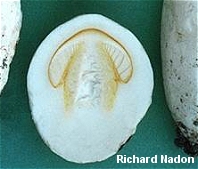
  • Puffballs – these are pretty common in Missouri and come in many forms but the ones that most people eat are the giant puffballs and the pear-shaped puffball. Both can be quite large so you may only need one or two for a meal. If you have ever come across a soccer ball sized one in the woods like I have you will know what I mean. Always cut your puffballs in half to make sure they are good to eat. They need to be all white flesh and show no black or dark spots. Also, they should not show any small mushrooms like the one pictured here:
    This is a amanita which emerges from an egg-like sac or volva. Amanitas contain some of the most deadly mushrooms found in North America, so if you cut into a puffball and see this, DO NOT EAT IT.


  • Chicken of the woods – this shelf fungus found throughout the summer and early fall is easy to recognize by its blazing orange color. It grows on wood, both living and dead, but can grow on decaying wood or roots underground giving it the impression of growing from the soil. Two varieties can be found in Missouri, one with white pores and one with yellow pores. The yellow pored variety seems to be harder to find, but there is no noticeable difference in taste between the two. As I said earlier, what effects taste and texture is the age. The younger, the fresher the better. On older specimens only harvest the fresh outer edges.
  • Shaggy Manes - I have only found a few of these and never enough to eat, so I do not know how they taste. But I know many hunters, especially those up north in Michigan, swear by them. Their shaggy appearance is unmistakable and makes it an easy mushroom for the kiddos to search out on family outings. Shaggies need to be eaten or prepared for storage almost immediately after picking. They begin to break down very quickly and if you are slow to cook them, you'll return to find only a bag of black goo.
  • Hen of the woods – or the Maitake mushroom as it is known in Japan is also called the dancing mushroom, perhaps because of the little dance one does when you find a 3 to 4 pound specimen. These tasty frond-like fungus are also sought after for their medicinal benefits and have been used to prevent and treat cancer and other diseases for centuries. They grow at the base of trees (usually oaks) and appear year after year. So once you find some good hen trees be sure to visit them every year for continued harvests.

Let me say a few words of caution before trying new wild edibles. As with anything some people have adverse allergic reactions to mushrooms, especially the chicken of the woods. So whenever you first try these only cook and make a little bit, say enough for a few bites. Eat this then if all is well, try a bit more the next day, working your way up to a full helping on the third day. As with anything never eat too many mushrooms. Too many of any mushroom, even morels, can make you sick. Also, do not drink alcohol while tasting wild mushrooms. I am not sure why, but even a single beer can cause some distress when combined with certain types of fungi. Last, but most important is the age old rule, “When in doubt, throw it out.” If you are not 100% confident in your identification, do not eat it. Follow these rules and you should do ok.

I would still like to hold a small foray soon but I am waiting until I see signs of the summer edibles out. There are a lot of mushrooms up and about and I have been out hunting down a few non-edibles for the camera with another local mycophile. As I am able to identify some of these, I will post them. They may not be edible but they sure are pretty and very interesting.

Good luck and keep hitting the woods. Let me know if you find anything. There should be some chants and other summer mushrooms showing up soon in the southern parts of the state.

Happy hunting.

Friday, May 23, 2008

No More Morels or Some Tips on Identifying Other Edible Mushrooms

Now that morel season has come to a close. It is time a good time to start learning about some other easy to identify edible wild mushrooms that you can hunt year round. Beyond the morel provides an overview of a few of these.

For those who have never hunted any of the other wild mushrooms, I suggest you learn to identify the deadly ones first. Although many mushrooms are poisonous, most just make you sick. However there are a few that are extremely toxic ones. Only a small bite of a galerina or a destroying angel can be enough to kill you. There have been many deaths attributed to eating poisonous mushrooms, but the ones below have been the most lethal and caused numerous deaths among both novice hunters and age-old pros. I cannot stress enough the old mushroom hunters adage "when in doubt, throw it out." There are old hunters and there are bold hunters, but there are no old and bold hunters. The most common deadly mushrooms found in our area that you should know are:
  1. Deadly Galerina (Galerina autumnalis)
  2. Destroying Angel (Amanita bisporigera)
  3. Death Cap (Amanita phalloides)
  4. The Jack O'Lantern (Omphalotus illudens)

Once you have memorized the traits of the deadly ones you can move on to the good ones. I recommend starting out with ones that have no poisonous look a-likes and do not require more extensive identification techniques such as spore printing and staining. Here is a list of ones to start with:
  1. Black Trumpet (Craterellus cornucopioides)
  2. Chicken of the woods (Laetiporus sulphureus)
  3. Hen of the woods (Grifola frondosa)
  4. Hedgehog or Sweet tooth (hydnum repandum)
  5. Lion's mane or Bearded tooth (my favorite is Hericium erinaceus)
  6. Indigo Milky (Lactarius indigo)
There are many others but they have some look-a-likes and so I will wait to talk about them. Do a little research and then after the next raining spell hit the hardwoods and you might be surprised at the abundance of wild mushrooms that are available throughout the summer.

If you would really like to learn more about mushroom identification proper, then I suggest you consider joining the Missouri Mycological Society (MoMs). They have an upcoming foray June 20-22 at Ha Ha Tonka State Park in south central MO. I am currently planning to attend. I am by no means a mycologists, so it is nice to go on forays and learn from those who are more professionally trained and those "so-called" amateurs who have been hunting for 30-50 years. The wisdom they share can be priceless. MoMs often holds forays in the eastern part of the state so this is a great opportunity to stay close and hunt with them in our own backyard.

Speaking of opportunities, MoMs is considering starting a central Missouri chapter, meaning there would be more opportunities for organized local forays around Mid-MO. I know a few of you have contacted me about hunting in the summer and fall. If you would be interested in joining a Mid-MO mushroom group, please let me know. If 5 to 10 people contact me, I would be more than happy to work with MoMs to set it up and organize some more structured forays in our area. Membership in MoMs is very reasonable ($15 annual dues) and the benefits and knowledge you can get are well worth the investment. I have met a few of the people and they are great. I have yet to make it to an event, but I hear the food cannot be missed. So, if this sounds like it might be for you, let me know.

With the rain last night and more predicted for this afternoon, I might just hit the woods this holiday weekend to see if there are any early black trumpets or chanterelles about. A lot of summer and fall mushrooms have also been reported to have overwintered and already been found. I myself came across some fresh small hericiums a few weeks ago and I have seen reports of some nice chicken of the woods already being found across the state. Usually I don't find these until June, but with such an exceptional spring for mushrooms there is no telling what may have popped up already. If anyone thinks they may be up for a hunt, let me know. I will probably be going out sometime on Sunday or Monday.

Happy hunting.

Wednesday, May 07, 2008

Storing your harvest for the rest of the year...

I posted this last year at the end of the season but for those who have missed it, here are the ways that I store my morels so I can eat them throughout the year. In case you hit the motherlode in the next few days here are some good tips to follow.

Drying morels

Whether you use an actual food dehydrator or just a heated room, like me, drying is one of the best ways to preserve your morels. Drying morels really concentrates the flavor and if dried properly they can last 3-5 years in storage. I dry mine simply by laying them out on old food dehydrator trays in a small room with baseboard heating that I can keep at a constant 95 degrees. Usually takes 2 days until they are completely dry. I don't turn them or rotate trays or anything and have never had bad results. Although simple a few things can go wrong but if you take some simple steps you can ensure success.

First, never wash or soak any morels you plan to dry. The dirt, bugs and gunk usually falls off once dried or you can rinse them thoroughly once rehydrated. If you soak the morels and then try to dry them often times you'll come back to find that they have turned somewhat translucent and are not good when rehydrated. I tend to dry smaller mushrooms usually ones found earlier in the year while still in their grey state. They make excellent soups, sauces, stocks and stews.

Second, never rush the drying process. I don't know how many times I have heard people say they dried a nice batch of morels and stored them only to come back and find a gnarly threadlike mess of mold and other fungi had destroyed their hard work. It even happened to me a few times with other types of mushrooms. So, always make sure that they are completely dry before packing them away for storage. All it takes is one partially dried mushroom to spoil a batch.

Which leads me to my final tip, always store your dried batch in airtight (and lightproof if possible) containers in the freezer. Air, light, and heat are the three things that will break down dried mushrooms. I store mine in dark mason jars. The jars hold up well against freezer burn and do not allow the mushrooms to get crushed like freezer bags (though those work just fine). I have stored morels for up to five years this way and the ones that were five years old tasted the same as the ones I dried only the year before. So if you have a bumper crop this is a good way to make sure you have some in future years when the pickings are more lean.

Flash fry and freeze

Drying is good, but if you are like me and what you really crave during the year is the taste of nice fresh fried ones, then drying just won't cut it. Once rehydrated and fried dried morels are chewy and lose that meaty consistency. But do not fret, there is a great way to prepare and store morels that not only makes them accessible all year, but very easy to enjoy. Here is what you do.

Simply clean, cut and prepare your morels like you would normally. This method works best when using a light coating, so if you usually batter your morels or dip them in egg/cookie crumbs it may be more difficult. I just clean mine, roll them in some seasoned flour and fry them up in butter. This method works very well for that.

Anyway, once you have them ready to go, simply fry them up like you normally would except only saute them for about 3 minutes on each side. After that remove them from the pan and place them on cookie sheets lined with wax paper. Be sure that they are not touching. Once the sheet is full of partially fried morels, pop it in the freezer and remove it after an hour or so. You can now peel off the individually frozen morels and store them in freezer bags. When you want some, you just take the amount you want and throw them right in a pan of hot butter and finish cooking them - instant gratification.

At the start of this season, I fried up what I had left over from last year along with some fresh ones and I had a real heard time guessing which was which in a blind taste test. If kept sealed properly they usually last about a year before freezer burn starts to set in, but most often they are long gone before then.

A second flush?

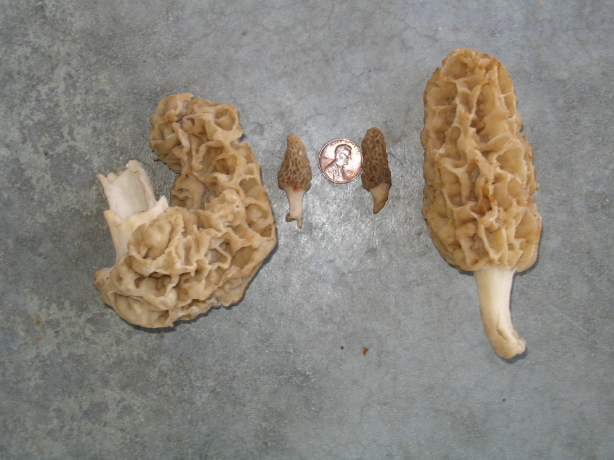
I have seen many reports by several hunters around the area finding fresh small ones. Camoshroomer was kind enough to send me this photo of some he found last Friday.

Those tiny ones in the middle make me think that perhaps some patches have indeed flushed again and sent up new mushrooms. I know I said that this usually doesn't happen, but this year isn't the usual season, it is ideal. With lots of rain, with cool temps with and only a handful of days above 75, it seems the season might hang on quite a bit longer. Get back out there, if you have not had your fill, there are still plenty to be found even some new ones, but be prepared to search among the undergrowth and check yourself for ticks. These late season hassles are well worth the effort when you come back with a nice mess of big yellows.

Monday, May 05, 2008

Taking a break...

I was out camping and hunting other things (not mushrooms) all weekend. I did happen to come across a few old and wise morels in my travels. They are still out there and worth hunting if your willing to really look, but with all the hunters that have picked the best patches and with the undergrowth now at least two feet tall, it often takes just blind luck to stumble upon some. But if you happen across a patch now even a small one, they should be truly big and worthy of the pan.

I remember back in the early 1990's when I took a break from studying and came across patches upon patches of big yellows in the middle of Rock Bridge State Park. My brother and I picked our shirts full and came back the next day with friends who all filled their sacks. This has been one of those seasons, so even though it is winding down, don't fret. If you didn't get your fill keep on hiking to deeper parts of the woods. You never know what you'll find.

My posts will be fewer (more like twice a week) now that morel season is winding down. But if you are interested in hunting the other easily recognizable edible mushrooms out there, let me know. I was thinking of maybe having a few summer forays if the weather is favorable. Black trumpets usually start up in June and they are mighty tasty, though some say they are one of the hardest mushrooms to spot. If you think you are up for the challenge.